Watergen GENNY Price, Specs and Models Compared
Short answer: Watergen does not publish a public price for the GENNY line. The unit is sold through regional distributors and quoted per order, which is why price comparison sites show wildly different figures. What you can pin down before requesting a quote is the running cost — and at the manufacturer's own stated efficiency of 400 Wh/L, that works out to roughly 25–30 cents per gallon at typical US residential electricity rates. That is about double the figure quoted in most YouTube reviews.
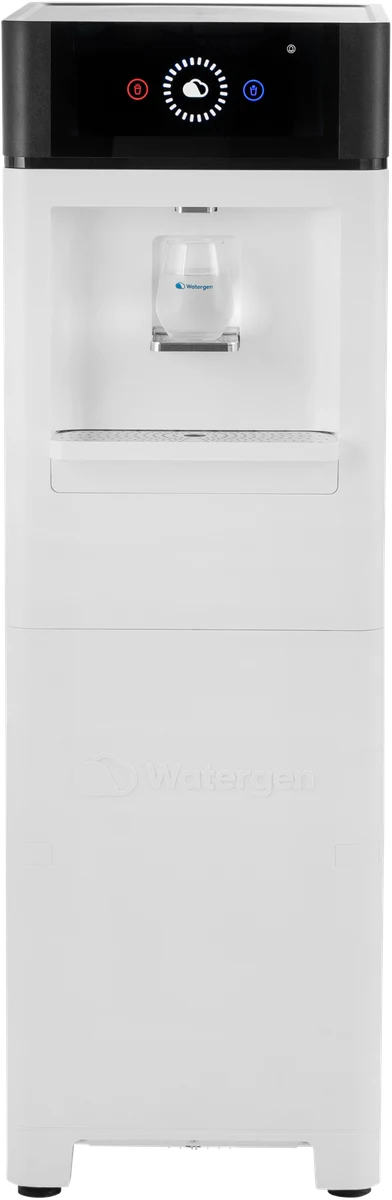
Below: how the three models actually differ (the naming is misleading), what the specifications commit to, and the math on operating cost.
The Three GENNY Models
Watergen sells three consumer units. The naming suggests a good-better-best ladder. It isn't one.
GENNY (Base)
Up to 30 L (8 gal) / day
Highest capacity and largest tank (23 L). Heavyweight floor unit (80 kg / 176 lb).
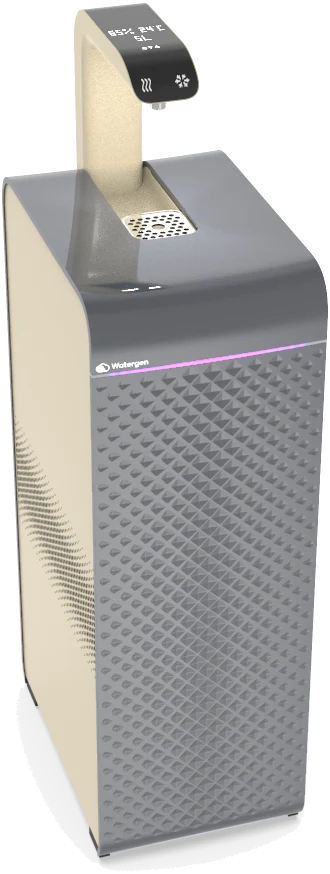
GENNY Home
Up to 20 L (5.28 gal) / day
Mid-sized residential unit with compact 9 L internal reservoir (60 kg / 132 lb).
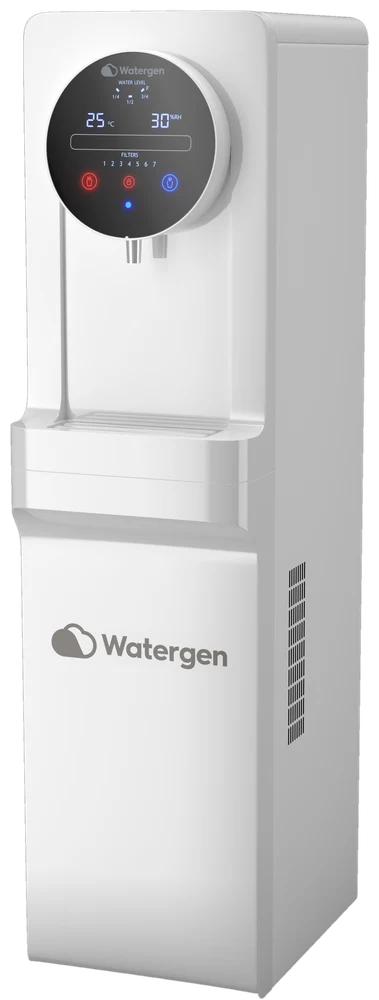
GENNY+
Up to 20 L (5.28 gal) / day
Smallest footprint and lightest weight (45 kg / 99.2 lb) with 11 L tank.
| Specification | GENNY | GENNY Home | GENNY+ |
|---|---|---|---|
| Daily production | Up to 30 L / 8 gal | Up to 20 L / 5.28 gal | Up to 20 L / 5.28 gal |
| Internal tank | 23 L / 6 gal | 9 L / 2.4 gal | 11 L |
| Dimensions (cm) | 54 × 42 × 130 | 51.3 × 34.2 × 125 | 44 × 30 × 115 |
| Weight | 80 kg / 176 lb | 60 kg / 132 lb | 45 kg / 99.2 lb |
| Power (nominal) | 550 W | 550 W | 550 W |
| Power (peak, US) | 1200 W | 1200 W | 1200 W |
| Efficiency | 400 Wh/L | 400 Wh/L | 400 Wh/L |
| Minimum conditions | 18 °C / 64 °F, 30% RH | 18 °C / 64 °F, 30% RH | 18 °C / 64 °F, 30% RH |
*All figures as published by Watergen on its official product pages.
Three things stand out.
- The "+" is the smallest unit, not the largest. GENNY+ is the ultra-compact model at 45 kg and 115 cm tall. It produces the same 20 L/day as GENNY Home in a smaller footprint. If you are shopping by model name expecting "+" to mean more output, you have it backwards.
- Only the base GENNY produces 30 L/day. It is also the one that weighs 176 lb and stands 130 cm tall. The capacity premium costs you floor space and 20 kg over GENNY Home.
- Efficiency and climate limits are identical across all three. Same 400 Wh/L, same 18 °C and 30% RH floor. Choosing between them is purely a question of output, tank size and footprint — not performance quality, and not cold-climate capability.
Why There Is No Published Price
Watergen's own product pages list full specifications and no price. The company sells through regional distributors and partner networks rather than direct retail, and quotes vary by country, import duty, installation and filter-service arrangements.
This is the honest answer to "Watergen GENNY price," and it is worth knowing before you start comparing listings: the figures you see on third-party marketplaces and reseller pages are those resellers' own numbers, not a manufacturer MSRP. Several listings that surface in search are for unrelated units that merely share the word "Genny." Verify the seller is an authorized Watergen distributor before treating any figure as the price.
💡 Contextual comparison: To see how commercial machines in this category stack up against other market offerings, consult our comprehensive guide on the best atmospheric water generators for home use, which reviews residential models alongside DIY alternatives.
To get a real number, request a quote through Watergen's regional site for your country. Ask the quote to itemize three things people routinely forget: delivery and placement for an 80 kg appliance, the replacement filter schedule and cost, and whether the unit carries a local service warranty.
What It Actually Costs to Run
This is the part you can calculate exactly, and it matters more than the purchase price over any reasonable ownership period.
Watergen states 400 Wh/L in standard conditions. That figure cross-checks against the other published specs: 550 W nominal draw running continuously for 24 hours is 13.2 kWh, and at 30 L/day output that is 440 Wh/L — the same order as the stated figure, with the difference accounted for by duty cycling.
⚡ Operating Cost Arithmetic (Standard Conditions)
- •400 Wh/L = 0.4 kWh per liter
- •1 US gallon = 3.785 L, so roughly 1.5 kWh per gallon
- •At $0.17/kWh (a common US residential average), that is about 26 cents per gallon
- •Running the base GENNY at full 30 L/day output draws roughly 12 kWh per day, or about 360 kWh per month
Plug in your own rate — electricity prices vary enormously by state, and the arithmetic is simple: your rate per kWh × 1.5 = your cost per gallon.
Two implications worth sitting with. First, 360 kWh/month is a significant load — comparable to adding several refrigerators to your home. Anyone evaluating an AWG for off-grid use needs to size solar and storage against that figure, not against the nominal 550 W. Second, the widely repeated "13 cents per gallon" claim circulating in video reviews is roughly half the figure the manufacturer's own efficiency spec produces at average US rates. It may hold at very low electricity prices or in ideal humidity, but it is not a number to budget on.
The 30% Humidity Floor
Every GENNY model stops at 18 °C / 64 °F and 30% relative humidity. Below either threshold, the published specification no longer applies.
That 30% RH floor is more permissive than many competing units, which is a genuine engineering advantage. But "works at 30% RH" is not the same as "produces 30 L at 30% RH." Atmospheric water generation output scales with available moisture, and the headline capacity figures are standard-conditions numbers. In a dry climate, expect meaningfully less than the rated output, and budget your cost-per-gallon upward accordingly, since the energy draw does not fall proportionally.
If you are in an arid region, this is the single specification that should drive your decision. [→ See our guide to AWG performance in low humidity]
What you can actually buy today
The GENNY's quote-only distribution is a real obstacle if you want a working unit this month rather than this quarter. Before you assume retail is the easier path, it is worth understanding what the retail side of this category actually looks like.
The retail AWG market is thinner than it appears
Search for a home atmospheric water generator on any major marketplace and you will find a dozen listings. Look closer and the picture changes.
Many of these units are the same hardware. Several listings under different brand names carry word-for-word identical product descriptions — the same unit, manufactured to the same specification, rebranded by whichever company imported that container. Choosing between them is choosing a seller, not a product.
The listings also turn over fast. Units that appear in stock one week are gone the next, and inventory counts in the low single digits are common. Several are sold by small importers rather than established appliance brands, and review counts in this category are frequently in the single digits — statistically meaningless on a purchase of this size.
Return terms deserve particular attention. Because these units contain refrigerant, shipping falls under hazardous materials regulation, and some sellers list them as non-returnable as a result. One current listing for a 20 L/day unit priced in the low four figures carries exactly that term: no returns, on an appliance costing as much as a used car. If the unit underperforms or arrives faulty, that is the buyer's loss. Check the return policy before anything else — it varies enormously between sellers of what may be physically the same machine.
None of this means retail is a bad route. It means the GENNY's distributor model, frustrating as it is, buys you something the marketplace often does not: a named manufacturer, a service network and recourse.
If you need more volume than the GENNY line offers
One unit worth knowing about sits above Watergen's entire consumer range. The VitalWater 60 L/day generator produces double the base GENNY's 30 L, in a floor-standing cabinet with multi-stage purification and a touchscreen controller. It ships with a 30-day return policy, which puts it ahead of much of the category on buyer protection.
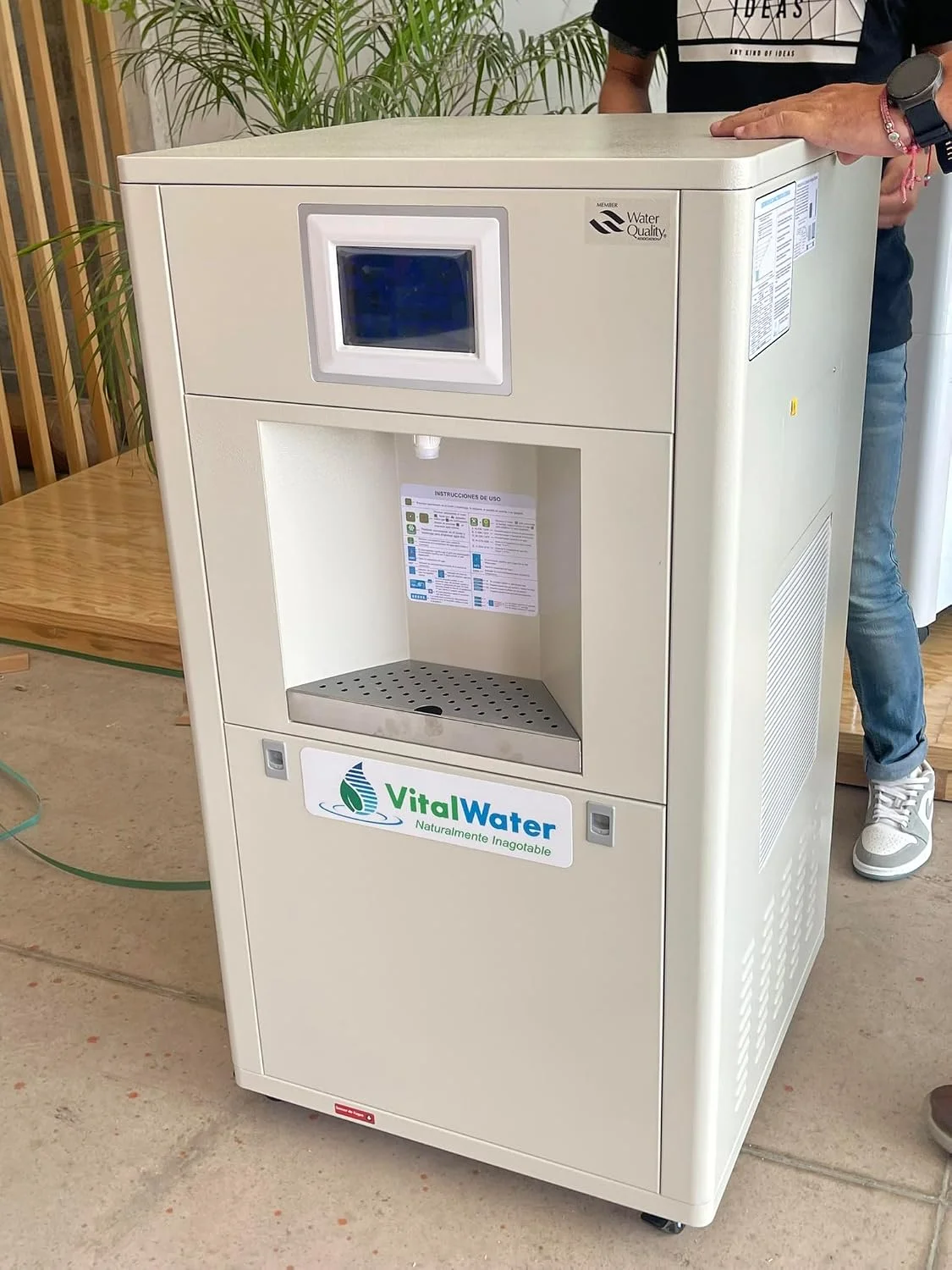
VitalWater 60 L/Day Atmospheric Water Generator
Floor-standing white cabinet with multi-stage water purification, integrated touchscreen controller, and double the daily output of the base GENNY (up to 16 gallons / 60 liters daily). Backed by a 30-day return policy.
One thing the listing does not state, and that you should factor in before buying: its energy consumption. If it runs at an efficiency similar to Watergen's published 400 Wh/L, 60 L per day would draw roughly 24 kWh daily — somewhere around $4 a day at average US residential rates, or over $100 a month in electricity alone. Ask the seller for the power specification before ordering. A unit that produces twice the water costs roughly twice as much to run, and at this capacity that figure stops being a rounding error.
Who each model is for
GENNY (30 L/day)
Households that want an AWG to be a primary drinking water source for more than two or three people, and who have the floor space for a 176 lb appliance. The 23 L tank also means it buffers better against peak demand.
GENNY Home (20 L/day)
The middle option. Reasonable for a couple or small family treating it as their drinking and cooking water. The 9 L tank is the real constraint here, not the daily output.
GENNY+ (20 L/day)
Same output as Home, smaller footprint, slightly larger tank at 11 L. The pick when space is the binding constraint. On the published specs it is arguably the better buy over GENNY Home unless the price difference says otherwise.
Before You Buy
An AWG is an appliance with an ongoing energy bill attached, not a one-time purchase. Work the running cost out at your own electricity rate first, then decide whether the unit price is worth it. If the math doesn't clear, a DIY build or a passive collection method may serve the same goal at a fraction of the operating cost.
Marcus Thorne
Preparedness & Water Systems Writer
Marcus Thorne writes on off-grid water independence, emergency preparedness, and atmospheric water harvesting technologies, focusing on realistic energy budgets and thermodynamic engineering.